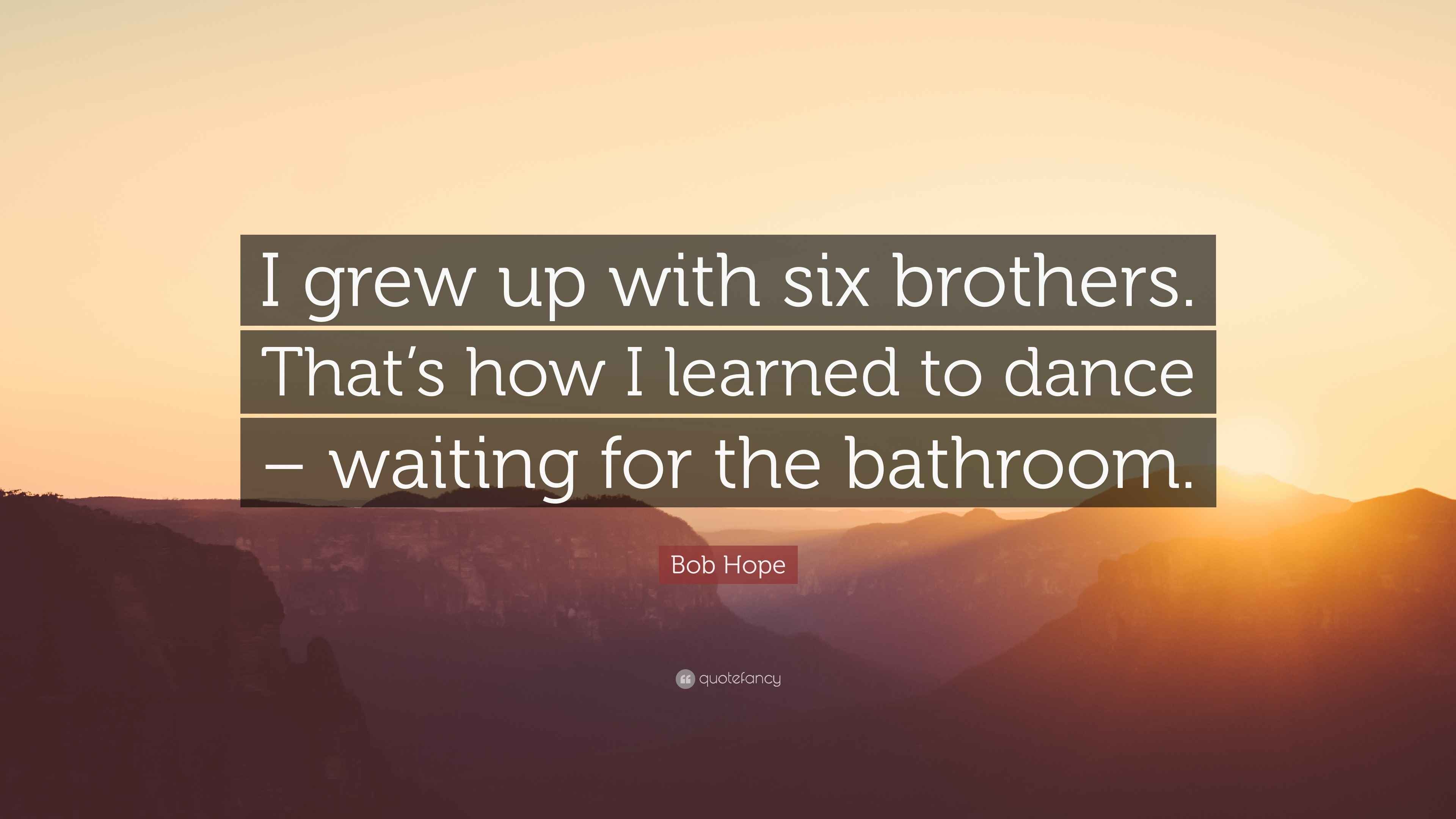
Growing up in a crowded household isn’t just about sharing bathrooms and hand-me-downs—it’s a masterclass in timing, survival, and subtle negotiation. When Bob Hope said, “I grew up with six brothers. That’s how I learned to dance—waiting for the bathroom,” he wasn’t just delivering a punchline. He was distilling decades of lived experience into a single, razor-sharp observation. Behind the laugh lies a blueprint for navigating relationships, embracing the quirks of aging, and understanding the unspoken politics of family and society.
This quote—often shared as a lighthearted “quote of the day”—resonates because it’s true on multiple levels. It’s funny, yes. But more importantly, it’s human. And that’s why it endures.
Let’s unpack what this one line reveals about life, not just for entertainers or large families—but for all of us.
The Humor That Hides the Hard Truths
Bob Hope’s comedy was never just about the joke. It was about the gap between what we say and what we mean. In this case, the surface-level gag is obvious: seven boys in one house meant constant competition for space, privacy, and resources. The bathroom becomes a battleground, and survival requires agility—hence, “learning to dance.”
But the deeper layer? It’s about adaptation. Waiting isn’t passive. It’s strategic. It’s reading the room, anticipating moves, and knowing when to step in—or step aside.
In relationships, this same skill applies. Whether it’s a marriage, friendship, or workplace dynamic, the ability to wait, observe, and respond with timing is often more valuable than speaking first. Too many people confuse assertiveness with domination. Hope’s line reminds us that sometimes, the smartest move is to bide your time—gracefully.
Real-world example: Think of a couple arguing over chores. The one who interrupts with frustration often escalates tension. The one who waits, listens, and then offers a solution? They’re “dancing.” They’re leading without appearing to lead.
Brotherhood as a Crucible for Character
Growing up with six brothers isn’t just a detail—it’s a formative environment. Sibling rivalry, alliances, pecking orders, and unspoken rules shape how a person moves through the world.
Hope’s upbringing taught him how to navigate hierarchy, competition, and cooperation—all essential skills in both personal and professional life.
Consider the politics of a large family: - There’s an informal economy of favors. - Reputation matters (you’re only as trusted as your last broken promise). - Humor becomes a tool for defusing conflict.
These aren’t just childhood survival tactics. They’re foundational to adult relationships.
Workplace parallel: In a team meeting, the person who dominates the conversation often gains short-term attention. But the one who listens, synthesizes, and speaks at the right moment gains influence. That’s the brother who learned to wait for the bathroom—and emerged with better timing.
Hope’s comedy career thrived on this kind of precision. His timing on stage, his rapport with audiences, even his famous USO tours—each required reading the crowd, adapting on the fly, and knowing when to deliver the punchline.
Aging and the Art of Graceful Exit

Bob Hope lived to 100. His longevity wasn’t just genetic—it was behavioral. His humor evolved, but never became bitter. He stayed relevant across decades by understanding one key truth: timing applies to exits, too.
The man who learned to dance while waiting for the bathroom also knew when to leave the stage.
In aging, many people struggle with irrelevance, loss of control, or clinging to past glories. Hope avoided that trap by embracing change—sometimes reluctantly, but always with wit.
His quote, while about youth, foreshadows a lifetime of patience and perspective. Learning to wait as a boy prepared him to wait well in old age—whether for recognition, for change, or for the next chapter.
Practical tip: As we age, we’re often waiting—medical results, family visits, societal recognition. The lesson? Use the wait. Refine your timing. Don’t rage against the delay. Dance through it.
Politics, Satire, and the Brother’s Eye View
Hope was one of the first comedians to regularly roast sitting presidents. His monologues at the White House correspondents’ dinner set the tone for modern political satire.
But his barbs never felt malicious. Why? Because he approached politics like a brother in a big family—critical, yes, but rooted in affection.
You can mock your sibling’s bad haircut because you love them. Hope treated American politics the same way. He poked fun at Eisenhower, Nixon, and Reagan—not to destroy, but to correct, to highlight absurdity, to keep power in check.
His brotherhood upbringing gave him a unique lens: - He understood hierarchy but didn’t fear it. - He knew when to challenge authority and when to let it pass. - He used humor as a peacekeeping tool.
Modern application: In today’s polarized climate, we could use more of this “brotherly” critique—sharp but not soulless, pointed but not personal. Not everything needs to be a war. Sometimes, it’s enough to say, “You’re being ridiculous,” with a smile.
The Dance of Modern Relationships
Hope’s bathroom line isn’t just about space. It’s about respect for rhythm.
In romantic relationships, mismatched rhythms cause more breakups than infidelity or money problems. One partner wants to talk at 10 p.m. The other needs silence. One plans vacations months ahead. The other thrives on spontaneity.
The solution? Learn to dance.
That means: - Recognizing your partner’s timing. - Adjusting your steps without losing your balance. - Knowing when to lead and when to follow.
Hope’s childhood forced him to develop this skill early. In a house full of brothers, you don’t get your way by demanding it. You get it by reading the moment.
Common mistake: Couples often try to “fix” timing differences with rules or ultimatums. But relationships aren’t procedures—they’re performances. You can’t choreograph everything. You have to feel it.
Humor as a Survival Skill
Let’s not overlook the most obvious lesson: laughter is armor.
Hope didn’t just make people laugh—he used humor to deflect pain, ease tension, and connect across divides. His quote about the bathroom isn’t just observational. It’s strategic. By laughing at the chaos, he reclaimed power over it.
Too many people treat humor as trivial. But in high-stress environments—families, hospitals, military zones, startups—laughter is often the first sign of resilience.
Realistic use case: A manager facing team burnout shares a self-deprecating story about a past failure. It’s not just “being nice.” It’s lowering defenses, creating psychological safety, and saying, “We’re all human. We’ll figure this out.”
Hope did this on a national scale. Whether entertaining troops overseas or hosting a TV special, his humor said: “We’re in this mess together. Let’s laugh our way through.”
Why This Quote Still Matters
In an age of curated perfection—Instagram lives, polished personal brands, and outrage-driven discourse—Hope’s quote stands out for its honest imperfection.
It reminds us that: - Crowded, chaotic beginnings can produce grace. - Waiting isn’t weakness—it’s wisdom in motion. - The best lessons often come wrapped in jokes.
We don’t need to grow up with six brothers to learn these truths. But we do need to recognize that life rarely offers solo turns on stage. Most of us are waiting our turn—whether for a promotion, a word in a conversation, or peace in a noisy world.
The question is: How do you wait?
Do you fume? Do you force your way in? Or do you observe, adapt, and step in with timing and grace?
Bob Hope chose the dance. And in doing so, he taught us all a step or two.
Final Thought: Make Waiting Work for You
Next time you’re stuck in line, on hold, or waiting for a reply, don’t reach for your phone out of frustration. Pause. Breathe. Ask: What can I learn in this moment? Who am I watching? What move comes next?
Because life isn’t just about the moments you lead. It’s about how you move while you wait.
Bob Hope didn’t just survive his six brothers. He learned from them. And now, we can too.
FAQ
What did Bob Hope mean by “I learned to dance waiting for the bathroom”? He was joking about the chaos of growing up with six brothers, but the deeper meaning is about timing, patience, and navigating crowded, competitive environments with grace.
How many brothers did Bob Hope actually have? Bob Hope had five brothers—William, John, Edward, Fred, and David. The “six brothers” line is a comedic exaggeration, common in stand-up storytelling.
Did Bob Hope have a close relationship with his brothers? While specific details are limited, Hope often referenced his large family in routines, suggesting a shared, chaotic upbringing that shaped his worldview and humor.
How did Bob Hope’s childhood influence his comedy? His working-class roots and crowded household taught him timing, resilience, and observational humor—key traits that defined his rapid-fire, relatable style.
What life lessons can we take from Bob Hope’s quote? Learn patience, read social cues, use humor to defuse tension, and understand that waiting isn’t wasted time—it’s preparation.
Is the quote about waiting for the bathroom real? Yes, it’s a well-documented line from Hope’s stand-up repertoire, often cited in biographies and comedy histories.
Why are old comedians like Bob Hope still relevant today? Because their humor was rooted in universal experiences—family, fear, aging, and resilience—making their lessons timeless despite changing cultural contexts.
FAQ
What should you look for in Bob Hope's Wisdom: Life Lessons from a Legendary Wit? Focus on relevance, practical value, and how well the solution matches real user intent.
Is Bob Hope's Wisdom: Life Lessons from a Legendary Wit suitable for beginners? That depends on the workflow, but a clear step-by-step approach usually makes it easier to start.
How do you compare options around Bob Hope's Wisdom: Life Lessons from a Legendary Wit? Compare features, trust signals, limitations, pricing, and ease of implementation.
What mistakes should you avoid? Avoid generic choices, weak validation, and decisions based only on marketing claims.
What is the next best step? Shortlist the most relevant options, validate them quickly, and refine from real-world results.